
My Puppy Wouldn't Stop Biting Me Until I Changed These 3 Things
Already saying no and redirecting to a toy, and your puppy still comes back at your hands? You are probably missing the one that is not about technique.
 By Ethan McMahon · November 20, 2026 · 7 min read
I adopted my first puppy when I was 18 — a Border Collie mix called Bubbles. I have been training dogs professionally for six years since, and I can tell you he is still one of the bitiest puppies I have ever had in my life.
Even now, if I want him to bite me, all I have to do is put on a jacket, push him around a bit and rile him up, and we are wrestling again.
So I am not writing this as someone who had an easy dog. The puppy biting phase is one of the hardest parts of raising a dog, and most owners are doing something that actively makes it worse without knowing.
You have probably tried some of this. Your puppy bites, so you push them away. You say no. You turn your back and walk off, because that is what the internet told you. Maybe you redirect them to a toy — and they take the toy, drop it, and come straight back at your hands.
Here are the three things that got me through it.
1. Keep a leash on your puppy, constantly
Let me paint the picture first, because the problem is usually invisible from inside it.
You are on the couch. Your puppy jumps up and wants to play. The way puppies start a game is with their mouth, so they start mouthing and biting you. You do not like it, so you say no, bad dog and push them away.
And your puppy comes back twice as hard.
Why pushing makes it worse
Think about what a litter of puppies does all day. They eat, they poop, they sleep, and they wrestle. And when they wrestle, they are biting each other constantly — teeth on each other, rolling around on the floor, having a wonderful time.
So when you push your puppy away and they flop onto the floor, they do not experience a telling-off. They experience you joining in.
Any time your puppy bites you and you touch them, talk to them, look at them or engage with them — they like it. Tail going, whole back end wagging. I am getting attention. This is great.
You have rewarded the biting.
Ignoring it is not the answer either. Their teeth are razors — you cannot sit there and be chewed on by a baby animal, and anyone telling you to is not the one bleeding.
The setup
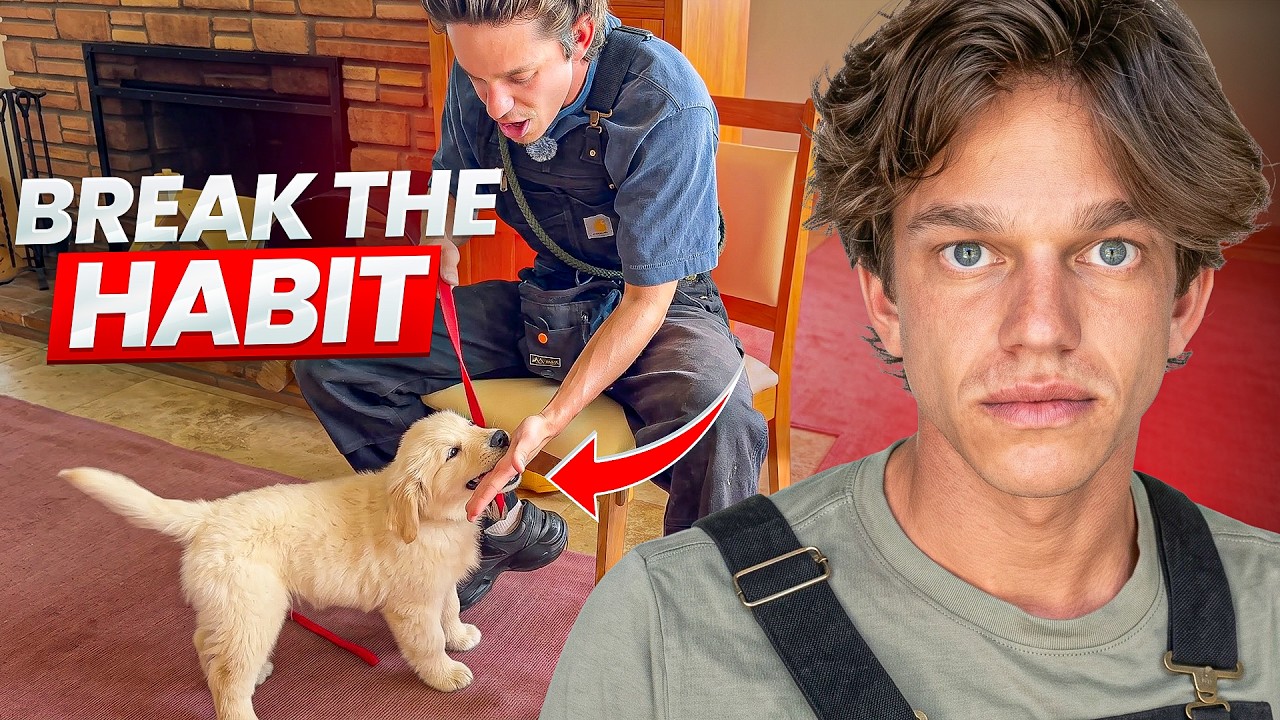
Put a flat collar on your puppy, fitted as snugly as a watch on your wrist. Clip on a thin, lightweight four-foot leash. Let them drag it around the house whenever they are out and supervised.
They may pick it up and chew it. That is fine. Pick your battles.
What to do when they bite
- Say no — once.
- Grab the leash and gently pull them away from you.
- Hold the leash out, keeping distance, until they relax.
- When they relax, say yes — and then give them a toy.
The reason this works where pushing does not comes down to one thing: you are not touching the puppy. No contact, no wrestling, no game. Just distance.
And on the redirection — the order is the whole point. Redirecting to a toy is a good thing to do. Redirecting at the moment they bite you teaches them that putting teeth on you is how you ask for a toy. Leash first, calm second, toy third.
I will say the obvious thing plainly: do not hurt your puppy. You are not throwing anyone across a room. It should simply be an experience your puppy does not find especially pleasant.
2. When nothing works, your puppy needs a nap
This is the one almost nobody gets to on their own.
Sometimes you will be doing everything above and thinking: Ethan, I'm doing the leash thing and it isn't working. He just comes back and bites me again, over and over. It's like he has puppy ADHD.
If your puppy genuinely cannot stop biting you, the usual explanation is not that the method failed. It is that they are tired, overstimulated, and need to sleep.
A tired puppy is a bitey puppy.
I train puppies for a living and I do one-hour in-home lessons here in San Diego, which gives me the same experiment several times a week. At the start of the hour the puppy is great. Halfway through, still great. And by about the fifty-minute mark, almost every puppy gets really bitey and really difficult.
It is the same mechanism as a four-year-old child. When a small human is tired they cry, they get cranky, the emotions go everywhere and the brain stops working the way you would like. Puppies are identical.
Now add your actual living room. You and your partner are home, the kids are around, the TV is on, something is cooking. Your puppy is exhausted — and cannot sleep, because there is far too much going on. Overstimulated and overtired at once. That puppy becomes extremely bitey, and no amount of leash work will fix a sleep problem.
What a puppy's sleep should look like
Vets generally recommend fourteen to sixteen hours of sleep a day.
For a puppy under five months, that means roughly six hours in the crate across the day and eight at night. I like a three-hour chunk in the morning and a three-hour chunk in the afternoon, plus the night.
"But don't use the crate as a punishment"
You will hear trainers say this, and they are right — so let me be precise about what I am recommending.
We are not putting the puppy in the crate because they bit you. We are putting them in the crate because they are exhausted and the room they are in is too loud and too busy for sleep to happen. It is a quiet dark bedroom, not a consequence.
Take them out to the bathroom, put them in the crate, and let them sleep. The biting problem you were fighting ten minutes ago frequently just disappears.
3. Give your puppy more things to bite
The last one is the simplest. Your puppy has to bite something — so stack the deck.
For working breeds especially, I want ten to fifteen toys in the living room at all times when the puppy is out and about.
Yes, your house will look a state. You have a puppy. That is the price of admission.
The point is options. A puppy standing in a room with one sad rope toy and a pair of your ankles is being asked to make a hard choice. A puppy surrounded by fifteen things they are allowed to destroy is being asked an easy one.
Make the contrast impossible to miss
This is where most people are too subtle, and your puppy does not speak English — all they have is your tone, your inflection and your body language.
So be theatrical about it:
- Puppy picks up a toy → "You're such a good boy! Good girl!" Go over. Tug it. Play. Pet them while they are holding it. Make it unmistakable that having a toy in your mouth makes you delighted.
- Puppy drops the toy and bites you → "No." Stone-cold face. Grab the leash, create distance.
- Puppy goes back to the toy → bright voice again, straight back to being the best puppy in the world.
Switching sharply between those two registers is doing more work than any individual technique on this page. It is the only vocabulary your puppy actually has.
The recap
- Keep a leash on. Use it to create distance when they bite — never your hands.
- If the biting is relentless, they need sleep. Potty, crate, nap. A tired puppy is a bitey puppy.
- Have a lot of toys out. Reward engaging with them enormously, and make the difference in your voice obvious.
The biting phase ends. Bubbles is proof it can end even with a dog who never really wanted it to.
Keep reading
- How to stop puppy biting: the 3-step method — the sequence itself, in detail, plus how to teach a puppy to be petted
- What puppies should actually be chewing — if the toys you have are not holding their interest
- Puppy biting and crate crying — the step-by-step fixes
Common questions
Why does my puppy bite more in the evening?
Because they are exhausted and cannot switch off. Evening is when the house is busiest — TV on, dinner cooking, kids about — so a puppy who badly needs sleep is too stimulated to take it. The biting is not defiance, it is a four-year-old melting down at bedtime.
How much should a puppy sleep?
Vets generally put it at fourteen to sixteen hours a day. Under five months, I want a puppy in the crate roughly six hours across the day — ideally a three-hour nap in the morning and another in the afternoon — plus the night.
Isn't crating a bitey puppy using the crate as punishment?
No, and the distinction matters. You are not crating the puppy because they bit you; you are crating them because they are exhausted and the room is too busy for them to sleep in. The crate is a quiet dark room, not a consequence — and the biting stops because the sleep happened.
How many toys should my puppy have out?
More than feels reasonable. For working breeds I want ten to fifteen toys in the living room whenever the puppy is out. Your home will look like a toy shop exploded. That is the price of having a puppy, and it makes the right decision the easiest one available.
What size leash should my puppy drag around the house?
A thin, lightweight four-foot leash, on a flat collar fitted snugly — about as snug as a watch on your wrist. Short and light so it does not snag on furniture, and only ever while your puppy is supervised.
Want this as a plan, not an article?
Boop gives you Ethan McMahon’s filmed curriculum in order, daily homework for your dog, an AI coach that answers in his words, and a live call with him every week.
The whole thing in one place: why the usual advice backfires, the six-step method on video, and the ten-minute exercise that stops it at the source.
Read the guide