
The Place Command: How to Teach a Dog to Settle Anywhere
One command does more for life in public than any other: go to this bed, lie down, stay until released. How to build it, from first paw to a busy park.
 By Ethan McMahon · November 22, 2026 · 8 min read
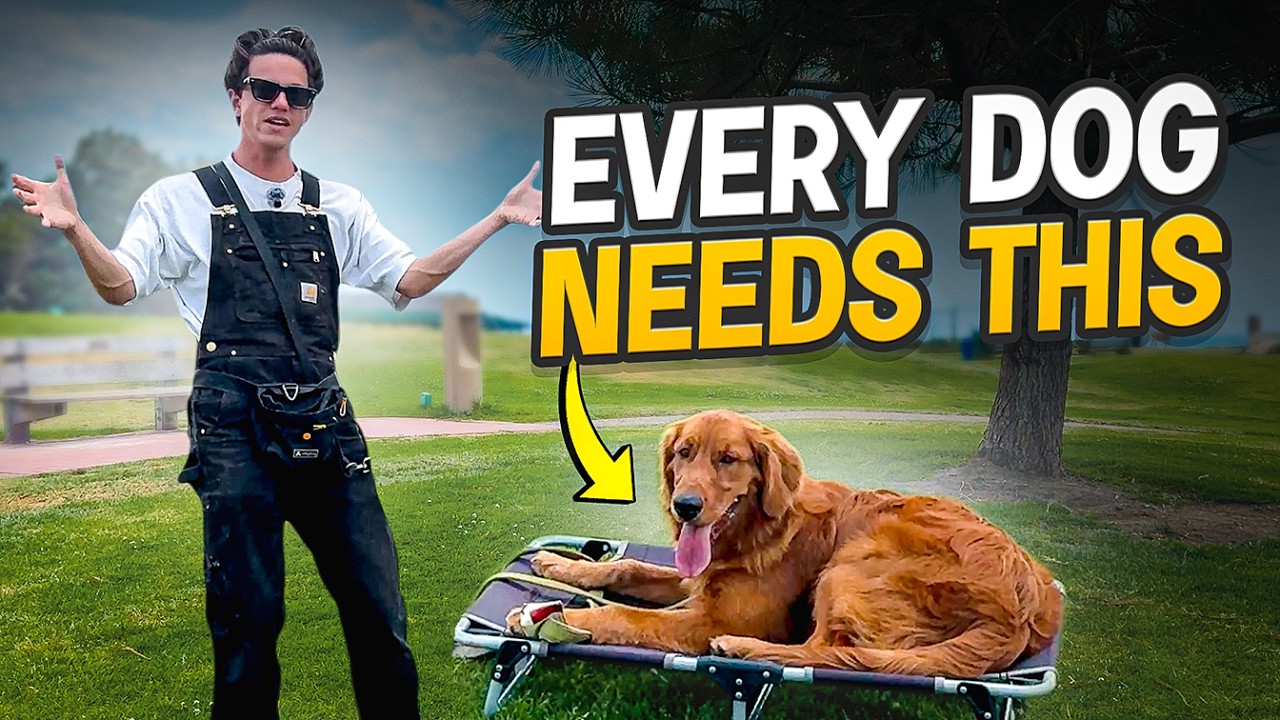
If you want to take your dog out in public but you cannot — because they will not settle, because they pull toward every dog they see, because they jump on every person who walks past — this is the one command that changes it.
I am teaching it here to Stanley, who is a fairly nervous dog and had never seen a cot before we started.
What "place" means
It is simple: go to this bed, lie down, and do not get up until I ask you to.
That is it. And it is the single most useful thing you can teach a young dog, because of where it works: an outdoor patio at a restaurant, a park bench on a busy afternoon, the corner of your living room when guests arrive.
It is also, quietly, the best socialization tool I know — and for a reason most owners never hear.
Rather than bringing your puppy to a park and letting them meet every person and every dog there, you can have them lie on a bed in a busy, active place and simply absorb the environment.
Meeting everybody teaches a dog that every human is an event. Lying calmly in the middle of a busy park while life goes past teaches a dog that the world is normal. Those two lessons produce completely different adult dogs.
Before you start
Begin in your backyard or your living room — somewhere with almost no distractions — and only work up to an open park with people and dogs once the behavior exists. Every stage below assumes you have done the previous one somewhere boring first.
You want high-value food, a leash on your dog, and an elevated cot.
On the cot specifically: you can use an ordinary dog bed, but I do not recommend it. What happens over time is that your dog starts lying on half the bed with the other half of their body on the floor, and they are slowly cheating the command out of existence. An elevated cot cannot be cheated — the edge is unambiguous, and your dog can feel exactly where it is.
One practical note, since Stanley and I filmed this in Southern California: if it is hot, work in the shade and keep sessions short. A dog that is overheating is not learning anything.
Step 1: get all four paws on the cot
Lure your dog up with food and reward them simply for standing on it.
That is the entire first step, and for a dog like Stanley — nervous, never seen one of these — it is a genuine ask. Sometimes it takes a small mental and physical nudge, a bit of gentle leash guidance alongside the food.
Reward all four paws on the bed, not two. Then toss a treat off the cot to reset, and do it again.
Repeat until getting on looks comfortable rather than brave. You will see the moment the confidence arrives: the step up stops being tentative.
Step 2: add the down
Before you ask for a down on the cot, check your dog can be lured into a down at all. If they cannot, there is a simple fix: hold a treat against the floor inside a closed fist and wait. Do not help, do not repeat anything. The moment they drop into the down, say yes and reward.
Then put the two together — lure up onto the cot, then lure down on it. Yes, reward.
No freebies along the way. Food comes out of your hand when the behavior happens, not before.
Step 3: now — and only now — add the word
You may have noticed that so far I have not once said the word "place".
That is deliberate, and it applies to every command you will ever teach a dog. Show the behavior first, then name it. If I had started shouting "place" while Stanley was still working out what a cot was, the word would have ended up attached to nothing, which is exactly how so many dogs end up ignoring commands they technically "know".
So, in order:
- Say the word once. "Stanley — place."
- Wait a couple of seconds.
- Then lure.
Not the word during the lure. The word, then the lure.
And when he looks confused, I do not repeat myself. I help — a little leash pressure, a little food, guiding him there — and then reward once he is actually on it. Because what I am really training in this moment is bigger than place:
Say the word once, then make sure it happens, without repeating yourself. You are teaching your dog to respond the first time you ask.
Repeat until the verbal command is doing the work, fading the lure out as you go. Keep the verbal praise loud and genuine. I want it obvious to Stanley that going and lying down when he hears that word makes me delighted.
Five to ten minutes, then a break.
Step 4: the hard part — staying there
Getting the dog onto the cot is the easy half. Keeping them there, against real distractions and real competing motivation, is the actual skill.
Reward much more often than feels necessary
Early on: mark and reward roughly every three seconds. Three seconds, yes, treat. Three seconds, yes, treat.
This is the number one mistake I see. People do not reward anywhere near frequently enough in the early stages, so the dog has no reason to still be there by second ten, and up they get.
Once it is solid, taper: every three seconds, then five, then ten, then fifteen. Slowly.
Add the distraction on purpose
Here is the thing worth being honest about. When your dog is lying there calmly, you do not actually know whether they are staying because you asked, or because lying down happens to be the easiest option available right now. Plenty of dogs are perfectly happy on a bed — right up until something interesting walks past.
So you have to find out, which means introducing the distraction yourself rather than waiting to be ambushed by it.
In the video I have the person behind the camera talk to Stanley, reach their hands out, and generally do what everybody does when they meet a Golden puppy.
If he gets up:
- Say no, once.
- Use the leash to bring him back to the cot.
- Gentle leash pressure to put him back into the down — more pressure only if gentle is not getting through.
- No treat for that repetition.
Then do it again. And again, until he does not get up.
Stanley got it almost immediately — by the second attempt you cannot get the dog to stand. He is clearly happy that people are talking to him. He just knows he is not getting up.
Your two words
This is worth stating plainly because the whole system runs on it:
- Yes — you did something good, and a reward is coming.
- No — you did something wrong, and a correction is coming.
A train went past while we were filming, and a dog walked by, and both are opportunities rather than problems: a dog who holds position through genuine environmental stress should be rewarded heavily for it.
And as you work with leash pressure over time, you need less and less of it. The dog learns what the signal means, and the signal gets quieter.
The food-distraction detail people miss
If you are handing your dog a treat and they lift up to take it — say no and take the food away.
Think about what otherwise happens: your dog lifts their elbows off the cot, and you put a treat in their mouth. You have just rewarded getting up. One repetition at a time, you are training the exact thing you are trying to prevent.
You can also deliberately toss food on the floor near the cot and reward them heavily for not going after it.
Step 5: the release word
Your dog needs a word that means you are done now.
Without one, you are leaving it to them to guess when they are free, and they will guess wrong repeatedly — and then get corrected for a decision you never gave them a way to make. That is not fair, and it is not training.
So: "Stanley — release." Then walk away from the cot and disengage completely.
When you first introduce it your dog will have no idea what it means and will not move. That is fine. Do not repeat it. Walking away is the message: the conversation we were having is over.
Putting it together
The full sequence, every time:
- "Stanley, place." Said once, and the only time you say it until the release.
- Guide him over, helping as much as necessary. Reward once he is on and down.
- He cannot get up until the release word. Every few seconds he stays: yes, food.
- Taper the rewards — three seconds, five, ten, fifteen.
- If he gets up: no, leash, guide back, down, no treat.
- "Stanley, release." Then walk away.
Keep a leash on your dog whenever you are working this — inside the house, outside the house, I do not care if you are in a tiny box room. You need to be able to pick it up and guide them back, and a dog you cannot reach is a dog you cannot help.
How much to practice
Two or three times a day, ten to fifteen minutes at a time.
The more you work it, the better it gets — and then you deliberately make it harder: busier environments, longer durations. Do that for a few weeks and you end up with a dog you can genuinely take anywhere, which is the whole point.
Where to go next
- Doesn't settle — the full protocol, including cafés and the doorbell
- Greeting people — for the jumping that place quietly solves
- Reactive to dogs — if the pulling toward other dogs is the bigger problem
Common questions
What does the place command mean?
Go to this bed, lie down, and do not get up until I release you. The release is the part that makes it a command rather than a suggestion — without a release word your dog is left guessing when they are free, and they will guess wrong over and over.
Do I need a special bed for place training?
An elevated cot is far better than a soft dog bed. On a flat bed, dogs gradually start cheating — half the body on the bed, half on the floor — and there is no clear line to hold them to. A raised cot has edges your dog can feel, so on and off are obvious to both of you.
How often should I practice the place command?
Two or three times a day, ten to fifteen minutes a session, with rest in between. Any one block of training should be about five to ten minutes before your dog gets a break — longer than that and you are working a tired dog, which teaches very little.
When should I start saying the word "place"?
Only once your dog is already stepping onto the cot and lying down for a lure. Say the word while they are still working out the behavior and it becomes background noise attached to nothing. Show the behavior first, then name it.
My dog gets up as soon as someone walks past. What do I do?
Reward far more often than you think you need to — every three seconds at the start — and then add the distraction deliberately rather than waiting to be ambushed by it. When they break, one "no", guide them back with the leash, put them back down, and no treat for that repetition.
Want this as a plan, not an article?
Boop gives you Ethan McMahon’s filmed curriculum in order, daily homework for your dog, an AI coach that answers in his words, and a live call with him every week.