
The 3 Mistakes I See in Almost Every New Puppy Home
After five years of in-home training, the same three mistakes turn up in nearly every new puppy home — and all three are fixable inside a week.
 By Ethan McMahon · November 16, 2026 · 8 min read
As an in-home trainer, I get to see what actually happens in people's living rooms — not what they tell me happens. And after more than five years of walking into homes with new puppies in them, across every breed, size and household setup you can imagine, I can tell you the three mistakes almost everyone is making.
None of them are about being lazy or careless. Every single one comes from a reasonable instinct that happens to be wrong.
Mistake 1: not using the crate enough
Let me be honest about why this happens, because I think most trainers skip the honest part.
You bring home a brand new puppy. They are cute, they are fluffy, and then everybody tells you to buy a crate. So you go crate shopping — and crates do not look nice. Metal wires, dark plastic shells, the whole thing looks like equipment rather than furniture. Then you put your puppy in one for the first time and they cry, a lot, and now you feel like a bad owner for ever having bought it.
So the crate gets used less and less. I understand it completely. It is also the most expensive mistake on this list, and here is why.
Crates are how puppies learn to hold it
I do not care where your puppy came from. Rescue, breeder, friend of a friend — if you have an eight-week-old puppy, it is not potty trained. And if the breeder told you it was, they were not telling you the truth. It is like saying a one-year-old child is potty trained. It just isn't a thing.
When an eight-week-old feels pressure in their bladder, they go. That is the whole decision-making process.
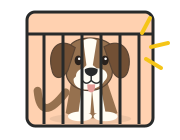
Unless they are in a small space. Puppies do not want to pee on their own feet, and they do not want to pee where they sleep — and that single instinct is the entire mechanism. A crate is not a cage, it is the tool that teaches a bladder to wait.
The rhythm looks like this: take your puppy out to the bathroom, crate them for two to three hours, take them out of the crate and straight outside again. Repeat. Their body gets onto a sleep cycle and a bathroom routine at the same time, which is what potty training actually is.
We have a free PDF roadmap that lays out the crate schedule I have found works best, hour by hour, if you want the version you can stick on the fridge.
Crates are also how you prevent separation anxiety
This one matters most if you work from home.
If you are around your puppy all day and all night, that is lovely — and if you never give them time alone, you are building a dog who cannot cope without you. Not a well-bonded dog. An unhealthily attached one. The bill arrives later: you cannot leave the house, the dog destroys things when you do, and it costs real money to fix.
You cannot explain this to a puppy. You cannot ask them to go and sit in the other room for a while. Puppies are pack animals and you are the mother — they will follow you from room to room for as long as you let them. The crate is how you give them space, because they will not take any on their own.
From eight weeks to about nine months: sleeping in the crate alone every night, plus two naps in the crate during the day, two to three hours each. That is the target.
Mistake 2: not using the leash enough — indoors
This one surprises people, so let me build it up properly.
Your vet has probably told you not to walk your puppy outside until the vaccination course is finished, because of parvovirus and distemper. That advice is correct and you should follow it — those diseases kill puppies and it is not a risk worth taking.
But people hear "no leash walks yet" as "no leash yet", and those are very different things.
What I want is your puppy dragging a leash and wearing a collar inside the house, whenever they are supervised and with you. Not alone. Not in the crate. Supervised, in the room with you, leash trailing behind them.
Here is what that leash is for.
It gives you a way to stop biting without joining in
Puppies bite. They play-bite, they do it constantly, and it is normal.
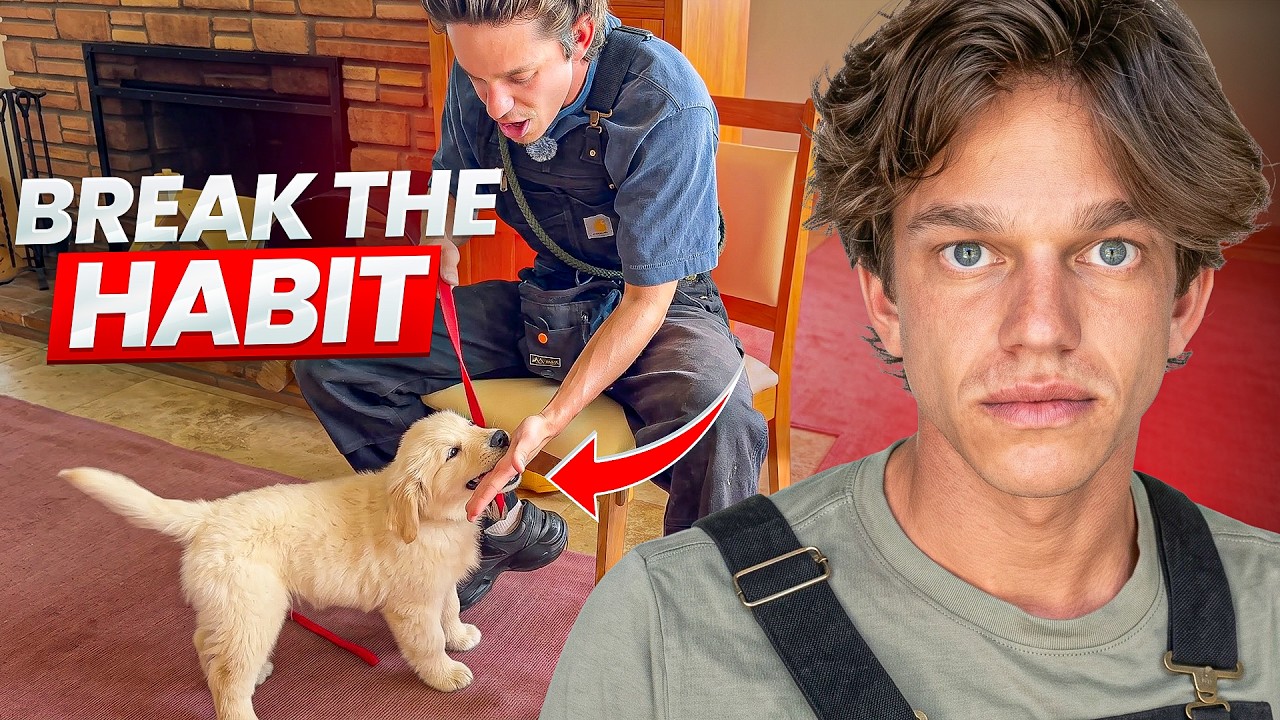
Now picture the usual response. Your puppy bites, you say no, bad puppy, and you push them away with your hands. From your puppy's point of view, you have just started a game. They bite, you shove, they get more agitated — and if you keep doing it, the lesson they learn is that biting you gets them touched and wrestled with. You have trained the thing you were trying to stop.
I am also not going to tell you to just ignore it, because if you sit there and take it you end up with needle holes in your forearms.
The leash is the third option. Your puppy goes to bite, you pick up the trailing leash and gently draw them away from you, and you hold them at that distance until they give up on the idea. Then — and only then — you redirect them onto a toy. No hands in the game, no wrestling, no reward.
It gives you a way to interrupt everything else
Puppy drifts toward the corner of the couch they have been working on all week? Pick up the leash, draw them away. No shouting, no chasing, no negotiation.
A leash indoors is the single best tool for setting clear boundaries about what a puppy can and cannot do, and hardly anybody uses it. The owners who do end up with the easiest adult dogs I meet, and it is not close.
Mistake 3: socializing your puppy wrong
This is the most important one on the list, and nearly everybody gets it wrong — because the word itself is misleading.
If I asked you what it means to socialize, and we were not talking about dogs, you would say something like: talking to people, chatting, meeting people. So when a trainer or a vet says socialize your puppy, what most people hear is my dog needs to meet as many dogs and as many people as possible.
Meeting dogs and people is good. It is not what socialization is.
What your dog actually needs to get good at is coexisting.
Your dog needs to be able to stand in a crowd of twenty people, greet one or two of them, and not greet the other eighteen.
That is the skill. And a puppy who was taught the other version — that every human is a greeting and every dog is a playdate — becomes an adolescent who screams at the end of the leash every time they see either. Most of the reactivity I am called in to fix started as enthusiastic, well-meant socialization.
What to do instead
Take your puppy out into the world without making the world an event.
Go to Home Depot. Go to the pet store. Go to safe places — and put your puppy in a shopping cart rather than on the floor, so you are not gambling with viruses while the shots are still finishing. Check with your vet about what is sensible where you live.
Bring genuinely high-value food. Cheese. Cooked ground beef. Shredded chicken breast. Not kibble — kibble does not compete with a hardware store.
Then play one game, which I call the name game:
- Say your puppy's name once. Do not repeat it.
- Wait for them to look at you. However long it takes.
- The moment they do, say yes.
- Give them the treat.
Do that everywhere you go. It is tedious and it is boring and it does not look like training. What it builds is a puppy who can give you their attention in a genuinely distracting environment — which is the foundation every other thing you will ever teach sits on top of.
The "say it once" part is not a detail. A name repeated five times becomes background noise, and then you have a dog whose name means nothing in public, which is where you need it to mean the most.
If you only change one thing this week
Put the leash on.
The crate schedule takes a few days to settle and socialization takes months of small trips. But a dragging leash costs you nothing, works from this afternoon, and quietly removes the two situations that cause new owners the most grief — biting and chewing — by giving you something to do other than use your hands.
Avoid these three and you are genuinely ahead of most puppy owners, and on course for an adult dog you actually enjoy living with.
Keep going
- Crate crying — what to do when the crate schedule meets a puppy with opinions
- Potty accidents — the other half of the crate routine
- Puppy biting — the full fix, beyond the leash interruption above
- Chewing — for the couch corner
Common questions
How much time should an 8-week-old puppy spend in the crate?
Between eight weeks and around nine months, a puppy should sleep in the crate on their own every night and take two naps in it during the day, two to three hours at a time. That sounds like a lot until you remember puppies sleep for most of the day anyway — you are choosing where it happens, not whether.
Is it safe to let my puppy drag a leash around the house?
Only while you are watching. A dragging leash is for a supervised puppy in the same room as you, so you can pick it up the moment you need it. Never leave a puppy alone wearing one, and never leave one on in the crate — a leash that catches on furniture or crate bars is a genuine hazard.
What does socializing a puppy actually mean?
Coexisting, not meeting. The goal is a dog who can stand in a crowd of twenty people, greet one or two, and ignore the rest — not a dog who has met the largest possible number of strangers. Most behavior problems I get called about come from dogs who learned that every person and every dog is an event.
Can I socialize my puppy before they have had all their shots?
Yes, with care, and your vet has the final word on what is safe where you live. Avoid the ground in places unvaccinated dogs use — dog parks, pet store floors, grass verges. Carrying your puppy or putting them in a shopping cart gets you the sights and sounds of the world with none of the risk.
Why shouldn't I push my puppy away when they bite?
Because from your puppy's side, being pushed is being played with. You push, they get more wound up, and you have just taught them that teeth on skin makes the game start. Picking up the dragging leash and holding them away from you ends the game instead of joining it.
Want this as a plan, not an article?
Boop gives you Ethan McMahon’s filmed curriculum in order, daily homework for your dog, an AI coach that answers in his words, and a live call with him every week.
The whole thing in one place: why the usual advice backfires, the six-step method on video, and the ten-minute exercise that stops it at the source.
Read the guide